
MIG/MAG vs spot welding: when each process fits
Frequently asked questions
Which is better, spot welding or MIG/MAG?
It depends on the joint. Spot is faster for overlapping sheets and repetitive series; MIG/MAG is more versatile for continuous beads and varying thicknesses.
Can one robot do spot and MIG/MAG welding?
Yes, with the right tooling, power source and programming. The cell can switch processes, but the decision must be validated with real parts.
Can TIG welding be automated?
Yes, although it usually requires tighter control of preparation, path and parameters. It is common in high-value parts or demanding finishes.
What does a robotic welding cell include?
Robot, welding power source, gripper or torch, tooling, positioners, safety, fume extraction, programming, testing and training.
In this article
Spot welding and MIG/MAG welding do not compete for the same job. One joins sheets by resistance at discrete points; the other deposits filler material to form a continuous bead. Choosing the wrong process forces a redesign of the cell, tooling and sometimes the part itself.
This comparison helps decide which process to assess first and what data an integrator needs to quote.
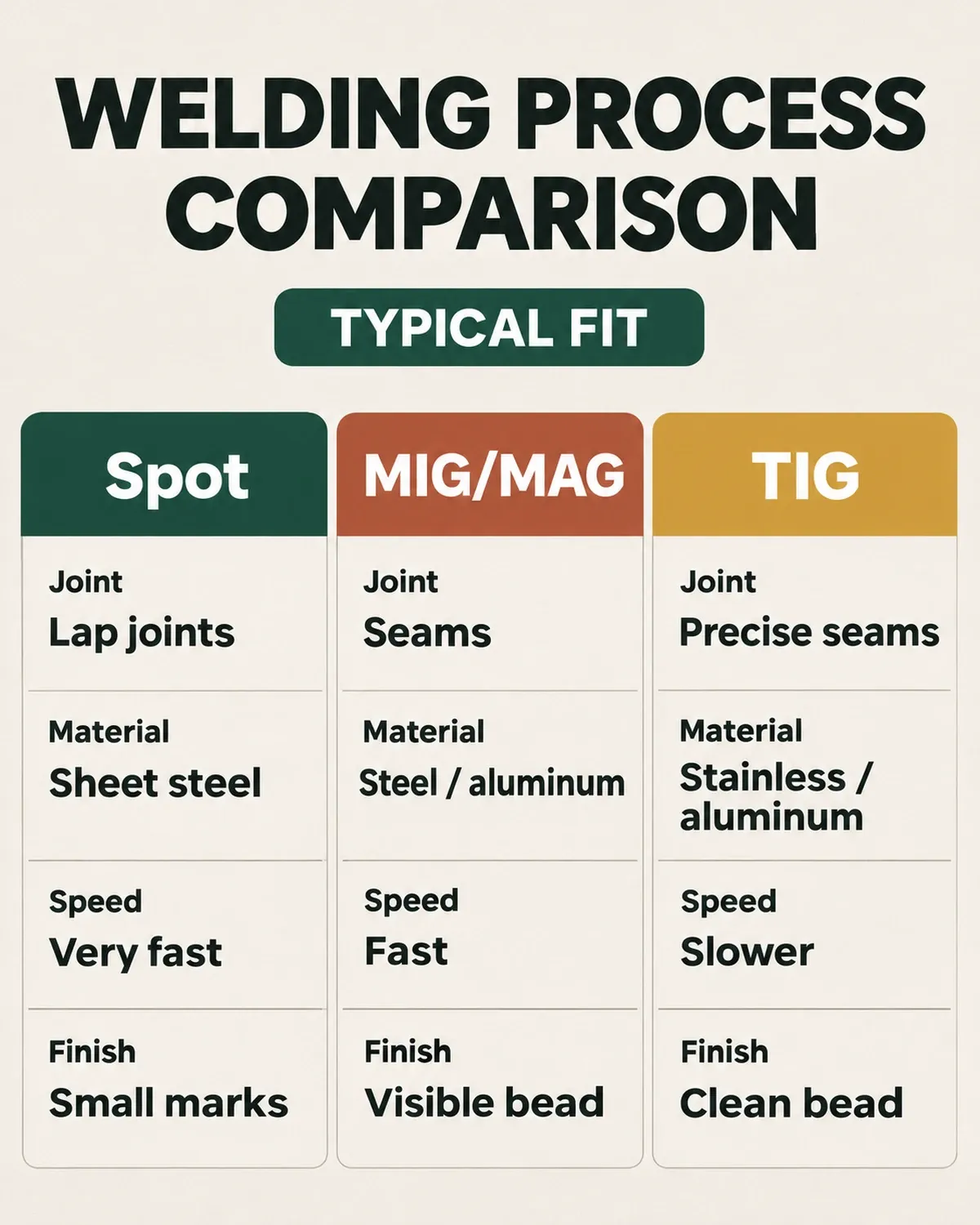
Three processes, three joining logics: the part and the volume define which one to assess first.
The difference in one sentence
- Spot welding: current and pressure on overlapping sheets; the spot is formed by resistance. Fast, repeatable and widely used in automotive bodies and sheet-metal structures.
- MIG/MAG welding: an electric arc with a filler wire forms a continuous bead. Versatile for thicknesses, positions and longer joints.
- TIG welding: an arc with a tungsten electrode and manual or automatic filler; greater control and finish, usually slower.
Comparison table
| Criterion | Spot | MIG/MAG | TIG |
|---|---|---|---|
| Joint type | Overlapping sheets | Continuous bead | Precision continuous bead |
| Typical materials | Steel, aluminum depending on equipment | Steel, aluminum, stainless | Stainless, aluminum, alloys |
| Thickness | Thin to medium sheets | Thin to thick | Thin and medium |
| Speed | High in repetitive series | Medium-high | Low |
| Finish | Localized spot | Bead with spatter depending on process | Clean finish |
| Automation | Highly repeatable with tooling | Requires path and parameter control | More sensitive to preparation and operator |
| Typical application | Automotive, appliances, sheet-metal structures | Structures, frames, vessels | Pipes, food, high-value parts |
What defines the choice
- The joint the design requires. Resistant spots or a continuous, leak-tight bead?
- Material and thickness. Not every process performs the same on aluminum, stainless or galvanized steel.
- Volume and cycle. Spot welding often wins in repetitive series; MIG/MAG in long beads.
- Gripper or torch access. Part geometry can rule out a process before cost comparison.
- Quality and inspection. A continuous bead may require porosity, penetration and finish control.
- The complete cell. Robot, power source, gripper or torch, tooling, positioners, safety and fume extraction.
When each one usually fits
- Spot: repetitive sheet-metal parts, overlapping joints, short cycles and stable tooling.
- MIG/MAG: frames, structures, long beads, varying thicknesses and production with several references.
- TIG: finish, precision, sensitive materials or beads where appearance and cleanliness are critical.
Mixed configurations also exist: a robot cell with tool changing, or a line with spot and bead stations. The decision is about process, not brand.
What data an evaluation needs
- drawings or sample parts;
- material, thickness and joint type;
- number and location of spots or bead length;
- volume, cycle and references;
- access, fixturing and space;
- quality, safety and fume extraction requirements.
With that data, spot, MIG/MAG and TIG can be compared on the same basis.
Common mistakes
- Choosing the robot before defining the welding process.
- Comparing equipment price without tooling, power source, safety and commissioning.
- Ignoring part preparation and torch access.
- Underestimating fume extraction and cell safety.
- Promising payback without real cycle and quality data.
How cycle time and quality are assessed
Welding cycle time is not just arc time. It includes loading, fixturing, approach, welding, cooling, unloading and, in many cases, inspection. A fast robot can lose its advantage if the part takes too long to fixture or if a reference change requires manual adjustment.
To assess cycle time, break the operation into steps and measure each one with real parts. Then add the variables that appear in production: program changes, worn electrodes, parts that do not fit, stops and rework.
Quality is defined before welding:
- which joint is considered acceptable;
- which defects are inspected and with what method;
- who validates the first part;
- what happens to an out-of-range part.
Without acceptance criteria, the process discussion becomes subjective.
Safety, fumes and standards
Welding generates fumes, radiation, spatter and electrical risk. The cell must be designed with a risk assessment, ventilation and fume capture at the welding point. In the United States, OSHA publishes requirements and guidance for welding, cutting and brazing; American Welding Society standards complement the technical process side.
Safety is not solved by a curtain alone. Review:
- fume extraction and air renewal;
- eye and face protection;
- appropriate clothing and gloves;
- grounding and electrical maintenance;
- energy lockout before intervention;
- access and emergency stops.
Specification mistakes
- Defining the process by the available machine rather than the joint.
- Comparing the robot price without the complete cell.
- Ignoring tooling and reference change time.
- Promising a cycle without testing real parts.
- Underestimating fume extraction and ventilation.
- Not defining who maintains electrodes and parameters.
Each of these mistakes appears after purchase, when the room to adjust is smaller.
Positions, preparation and repeatability
Welding position changes process difficulty. Welding flat is not the same as vertical or overhead; MIG/MAG and TIG behave differently depending on position, material and filler. Part preparation —cleaning, bevel, gap and fixturing— also defines quality.
In automation, preparation repeatability matters as much as robot repeatability. If the part arrives with variation, the robot repeats the path but does not fix the joint. That is why the assessment includes tooling, tolerances and incoming part control.
In summary
Spot, MIG/MAG and TIG solve different joints. Choose by part, material, volume and quality requirements, then design the complete cell. The process decision comes before the equipment decision.
In summary
The process decision comes before the equipment decision. Compare the joint, material, volume and quality requirements, then design the cell around the chosen process.