
Spot welding robot: how to assess whether it fits your plant
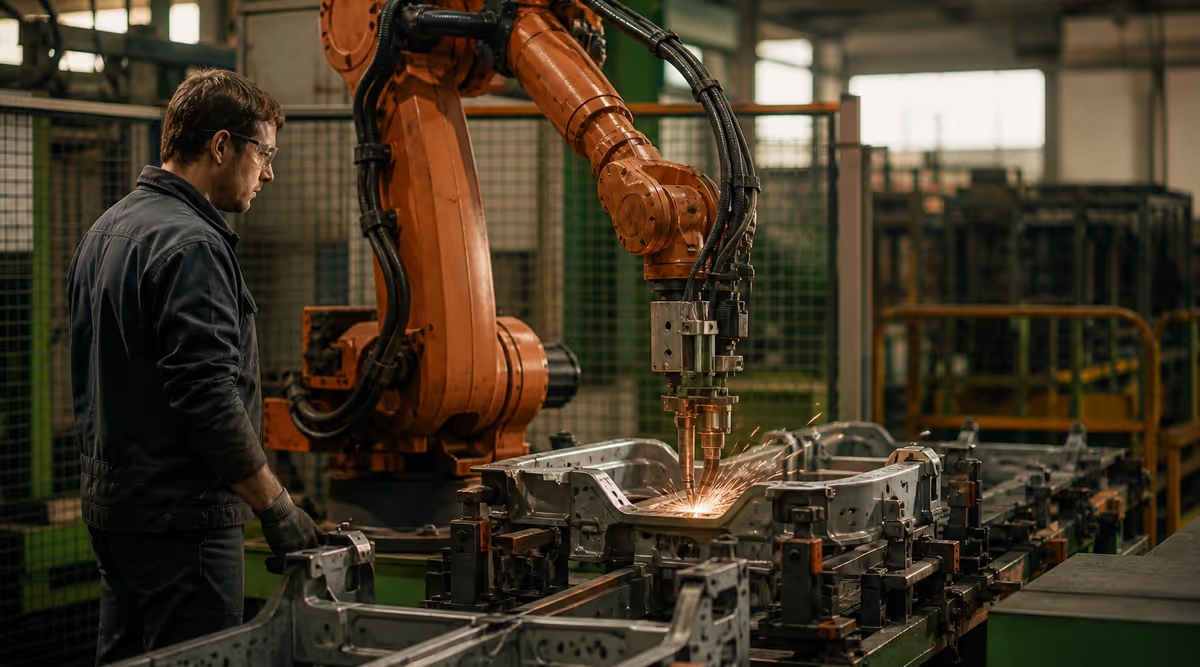
If you are looking for a spot welding robot, you have probably identified part of the process that needs more repeatability, capacity, or control. The decision is not just about selecting a robotic arm: you need to assess the parts, spot sequence, production volume, and complete cell.
This guide brings together the criteria worth reviewing before requesting a quote or defining a purchase.
What problem are you trying to solve?
Automated spot welding can make sense when the same joints repeat across parts or assemblies that can be held in a stable fixture. Before looking at equipment, define what is holding the operation back today:
- variation from one part to the next;
- cycle times that are difficult to sustain;
- rework or quality checks that are hard to repeat;
- dependence on one person for a critical task;
- the need to increase capacity without adding the same number of manual hours.
If the problem is different — continuous welds or highly variable parts, for example — a MIG/MAG robot, TIG process, or another solution may be more appropriate.
1. Review the parts before the robot
Geometry determines whether the gun can reach every spot and whether the assembly can remain in position during the cycle. For the survey, collect:
- representative drawings or samples;
- material and thickness for each component;
- number and location of the spots;
- tolerance and finish requirements;
- the orientation in which the part enters and leaves the cell.
Knowing how many spots a part has is not enough. Access, possible deformation, fixturing, and welding order matter as well.
2. Measure volume and repetition
A welding robot is more likely to fit when a sequence repeats often enough to justify preparing the cell. Record:
- units per shift or day;
- current cycle time;
- number of part references or models;
- fixture change frequency;
- pauses, waiting, and rework that affect flow.
Short series can also be automated, but the proposal should then prioritize flexibility, fast changeovers, and programming the team can maintain.
3. Compare the right process
“Welding robot” does not describe one single process. The right alternative depends on the joint and the result you need:
| Process | Usually assessed when | What to review |
|---|---|---|
| Spot welding | Localized joints repeat on positioned parts | Gun access, sequence, pressure, and fixturing |
| MIG/MAG | Continuous welds are needed on repetitive series | Path, deposition, position, and arc stability |
| TIG | Arc control and finish are especially important | Preparation, speed, material, and tolerances |
The choice should not be based only on which robot is available. It must answer the material, thickness, part, and real production pace.
4. Think about the complete cell
The arm is one part of the system. A robotic welding cell may also require:
- a spot gun or suitable torch;
- fixtures and positioners;
- controllers, power source, and wire feed;
- guarding, sensors, and safety conditions;
- path programming;
- testing with real parts;
- training and documentation for the team.
That is why a welding robot integration assessment should consider the relationship between equipment, process, people, and available space.
Checklist before requesting a proposal
This information speeds up the assessment:
- Which parts do you want to weld, and at what volume?
- Is the current process spot, MIG/MAG, TIG, or something else?
- What measurable problem do you want to improve: time, variation, capacity, or rework?
- What floor space and utilities are available?
- Which part of the operation must remain manual?
- Who will operate, maintain, and validate the cell?
If you do not have every answer yet, that is fine. Industrial automation strategy consulting helps structure the information and compare alternatives before a purchase.
What should the proposal include?
A useful proposal should make clear what is delivered, what is excluded, and how the result will be validated. At minimum, ask it to detail:
- cell and equipment scope;
- parts and references considered;
- cycle and volume assumptions;
- safety and integration requirements;
- programming, testing, and training;
- stages, owners, and acceptance criteria.
The goal is not to buy technology for its own sake. It is to build a solution that can work in your plant and that the team can sustain after commissioning.
Conclusion
A spot welding robot can be a good decision when the process is repetitive, parts can be accurately fixtured, and there is a clear operational problem. If the decision focuses only on the arm, the factors that most affect the outcome are left out.
You can review the industrial welding robot specifications or tell us what is holding your process back to assess the next step.