
Industrial welding robot: spot, MIG/MAG and TIG
Industrial welding robot for spot, MIG/MAG and TIG welding. We evaluate parts, volume, reach and line integration before proposing a cell.
automation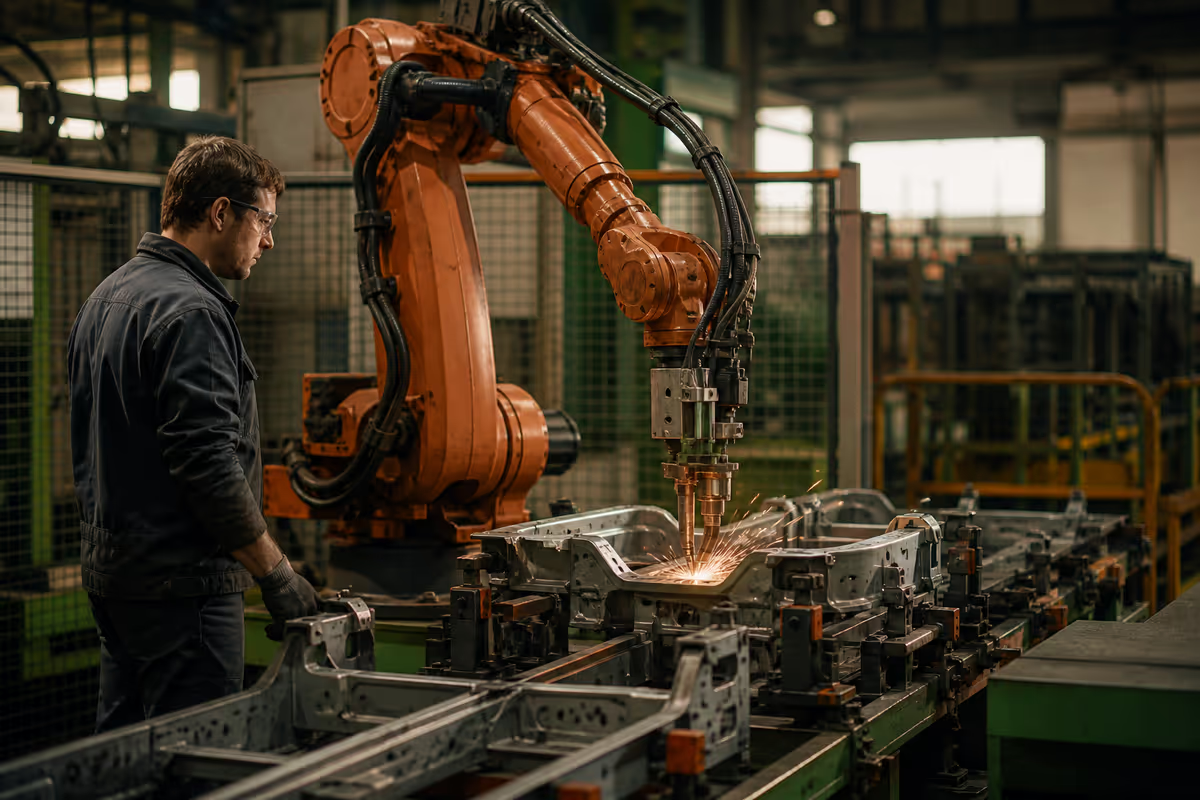
Automate your welding process with a cell designed around your parts, production volume, and existing plant integration. This industrial welding robot can be configured for spot, MIG/MAG, and TIG welding.
The selection does not start with the robot arm. It starts with understanding the parts you weld, the number of cycles you need, and the repeatability your operation must maintain.
Spot, MIG/MAG and TIG welding robot
Each process requires a different cell configuration and evaluation:
- Automated spot welding: for repeatable sequences on parts and assemblies that can be accurately fixtured.
- MIG/MAG welding: for continuous welds and series where path, deposition, and process stability matter.
- TIG welding: for applications requiring tighter control of the arc, finish, and part preparation.
- Laser welding: available as an option to assess according to material, thickness, and production goals.
Technical specifications
- Axes: 6 degrees of freedom
- Repeatability precision: ±0.08mm
- Payload capacity: 10 kg
- Reach: 1,444 mm
- Maximum speed: 500°/s
- Weight: 28 kg
Supported processes
- MIG/MAG
- TIG
- Spot welding
- Laser welding (optional, depending on the project)
Benefits
- Consistency: repeatable paths and parameters in every cycle.
- Productivity: more capacity for repetitive series without relying on constant manual operation.
- Quality: controlled process parameters and traceability for each part configuration.
- Safety: the operator supervises the cell from a protected position designed for the operation.
How do we assess whether the robot fits your plant?
Before defining a proposal, we review:
- part geometry, material, and thickness;
- production volume and cycle count;
- joint type and access required by the torch or gun;
- fixtures, positioners, and available floor space;
- line integration, safety, and operator training.
This assessment helps prevent buying a standalone device that cannot sustain the pace, quality, or integration your operation requires.
Includes
- Industrial controller
- Offline programming software
- Integrated welding source
- Torch and cabling
- Initial training
Optional
- Artificial vision system
- 2-axis positioner table
- Complete safety cell
Frequently asked questions
Can the robot perform spot welding?
Yes. Spot welding requires reviewing gun access, spot sequence, part geometry, and the fixturing system. Those inputs determine the cell configuration.
Can it work with MIG/MAG?
Yes. It can be configured with the source, torch, wire feeder, and programming required for MIG/MAG. The proposal depends on material, thickness, weld type, and production pace.
What do we need for an assessment?
Share the parts you want to weld, available drawings or samples, approximate volume, current process, and line constraints. That is enough to identify what should be surveyed before selecting equipment.
Is integration included?
The robot can be part of an integration proposal covering fixtures, safety, programming, testing, and training. Learn about welding robot integration.
If you are not sure whether automation is the right step, start with industrial automation consulting and structure the decision before buying technology.