
Industrial cobot: what it is, types and when it fits
Frequently asked questions
Is a cobot safe without fencing?
Not necessarily. Safety depends on the risk assessment of the complete application. It may require guards, sensors, speed limits or emergency stops.
Can a cobot replace an operator?
It can automate part of a task, but it does not replace human judgment in exceptions, quality or decisions. Most successful projects redistribute tasks rather than eliminate the role.
What is the difference between a cobot and an industrial robot?
A cobot is designed to operate near people with force and speed limits; an industrial robot prioritizes speed, payload and repeatability in fenced cells. The real difference is in the application and safety.
Can I start with a cobot and scale later?
Yes, if the architecture and integration are designed to grow. A scoped pilot validates cycle, quality and safety before expanding.
In this article
An industrial cobot is a robot designed to share space or tasks with people. Its promise is not to replace the operator, but to help with repetitive movements, loads, inspection or machine loading and unloading without requiring a closed cell in every case.
That promise has limits. A cobot is not automatically safe, not always cheaper and not always faster. The decision depends on the task, part, cycle, tool and risk assessment.
What a cobot is and what it is not
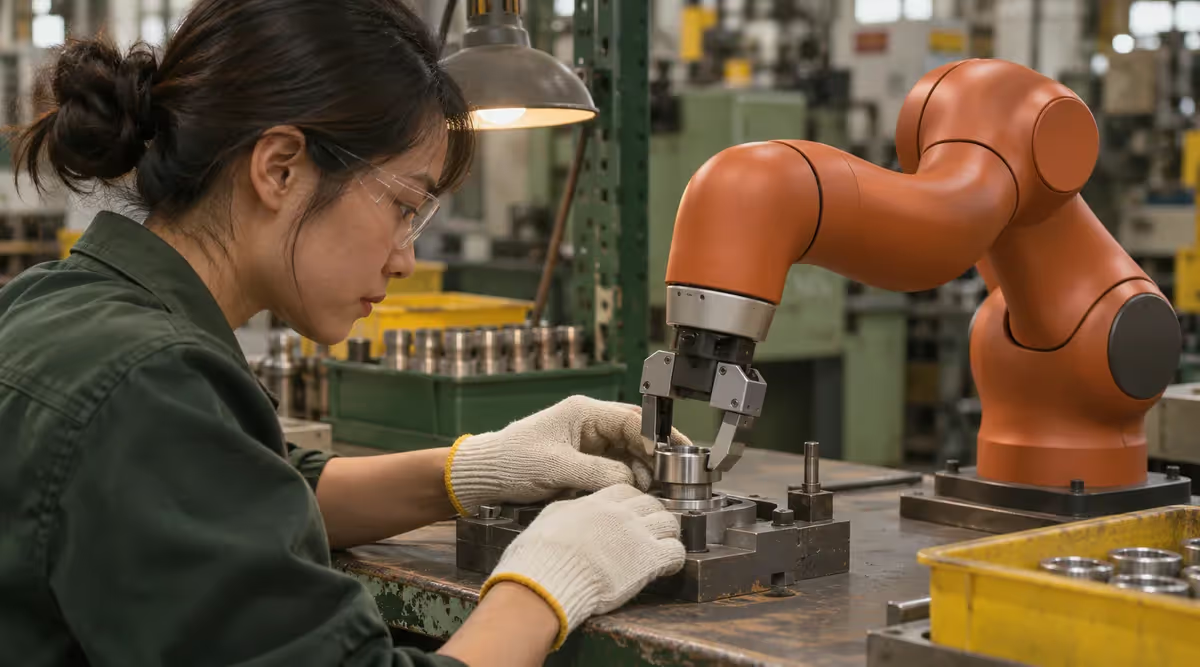
A cobot is a robotic arm with collaborative operating modes, force and speed limits, and sensors that can detect contact or presence. It can work near a person, but safety is assessed on the complete application: tool, part, speed, space and operating mode.
It is not an industrial robot “without a fence”. It is not a desktop toy either: many industrial cobots handle meaningful payloads and require integration, programming, tooling and maintenance.
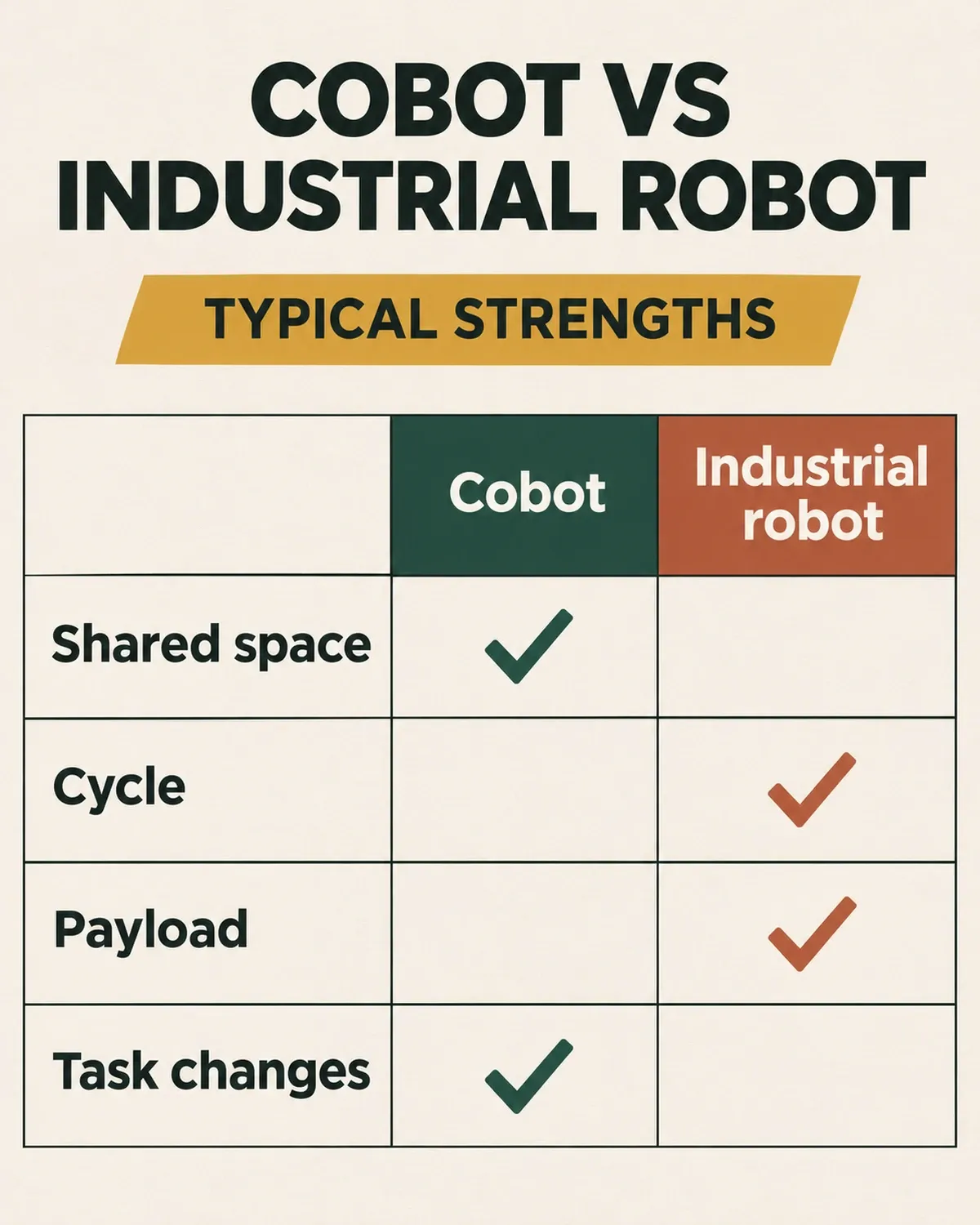
The typical advantage of each option depends on the application, not the equipment label.
Types and configurations
- Tabletop or small cobot: light parts, laboratory, dosing, screwing, inspection.
- Medium-payload cobot: machine loading and unloading, light palletizing, assembly.
- Mobile cobot: arm mounted on an autonomous platform for multiple stations.
- Cobot with dedicated tooling: welding, dispensing, screwing, vision or gripping.
The category matters less than the cell: tooling, fixturing, sensors, safety and controls define the result.
Typical applications
- Loading and unloading CNC, injection molding or press machines.
- Assembling small and medium parts.
- Screwing, dispensing and marking.
- Inspection with machine vision.
- Light palletizing and end-of-line tasks.
- Welding in applications where cycle and safety allow it.
In every case, the question is the same: is the task repeatable, can the part be fixed, and does the cycle allow the cobot’s speed?
Cobot vs industrial robot
The industrial robot usually wins on speed, payload, repeatability and sustained production. The cobot usually wins on flexibility, shared space and frequent task changes. The honest comparison is between complete cells and total cost, not the arm price.
The full industrial robot vs cobot comparison develops the payload, cycle, safety and cost criteria.
How much does a cobot cost
There is no single price. Cost includes arm, tooling, fixturing, sensors, safety, programming, integration, training and maintenance. A low-priced cobot with a poorly designed cell can end up costing more than an integrated solution.
Before asking for prices, define the task, part, cycle and required safety level. With that data, one proposal can be compared with another.
When a cobot does not fit
- When the cycle requires sustained speed that collaborative mode does not allow.
- When the part or tool creates a risk that requires fencing.
- When the task changes so much that programming becomes the bottleneck.
- When volume does not support the investment.
- When the process is not stable yet.
How to assess safety in a collaborative application
Safety is not decided by the “collaborative” label. It is assessed on the complete application: robot, tool, part, fixturing, speed, force, space and people. Reference standards —ISO 10218 for industrial robots and ISO/TS 15066 for collaborative systems— structure the analysis, but they do not replace a risk assessment for the specific case.
Some points that usually define the design:
- Possible contact: which body part can contact which tool and how.
- Force and pressure: allowable limits by body zone and contact type.
- Speed and separation: operating modes, speed reduction and safety distances.
- Guards: when a light curtain, scanner or fence is required.
- Emergency stop: accessible and tested in the real operation.
A cobot can share space, but the assessment may conclude that it needs guards, sensors, limits or specific operating modes. That result is part of the project, not a commissioning surprise.
Costs that do not appear in the quote
The arm price is only one part. Total cost includes:
- tooling and gripping system;
- fixtures and part-specific equipment;
- safety sensors and guards;
- integration with PLC, vision or management systems;
- programming and testing;
- team training;
- maintenance, spare parts and upgrades.
A low-priced cobot in a poorly designed cell can cost more than a well-integrated industrial robot. The right comparison is between complete cells and cost per cycle, not isolated equipment.
Pilot and acceptance criteria
Before scaling, test the application under real conditions. The pilot should define which part, cycle, quality and level of human intervention will be measured. It should also include difficult cases: mispositioned parts, reference changes, stops and recovery.
Typical criteria:
- sustained cycle during a shift;
- repeatability and quality within tolerance;
- human intervention rate;
- reference change time;
- safe behavior after contact or stop.
If the pilot does not meet them, buying more equipment will not fix it. Adjust the scope or revisit the alternative.
Common mistakes when evaluating a cobot
- Comparing only the arm price and not the complete cell.
- Assuming collaborative mode removes the risk assessment.
- Choosing by nominal payload without considering tool, inertia and cycle.
- Ignoring programming time and reference changes.
- Buying a cobot for a task that actually needs an industrial robot.
The decision improves when complete cells are compared on the same criteria: payload, cycle, safety, flexibility and total cost.
In summary
A cobot is a tool for a specific application, not a universal replacement. Evaluate the complete cell, the risk assessment and the total cost before assuming it is simpler or cheaper.