
Cobots and industrial robots in 2027: growing applications and decisions that do not change
Frequently asked questions
Cobot or industrial robot?
It depends on payload, cycle, safety, space and total cost. The cobot wins on flexibility and shared space; the industrial robot usually wins on speed, payload and repeatability.
Is a cobot safe without fencing?
Not necessarily. Safety depends on the risk assessment of the complete application: tool, part, speed, force and space.
Which applications are growing?
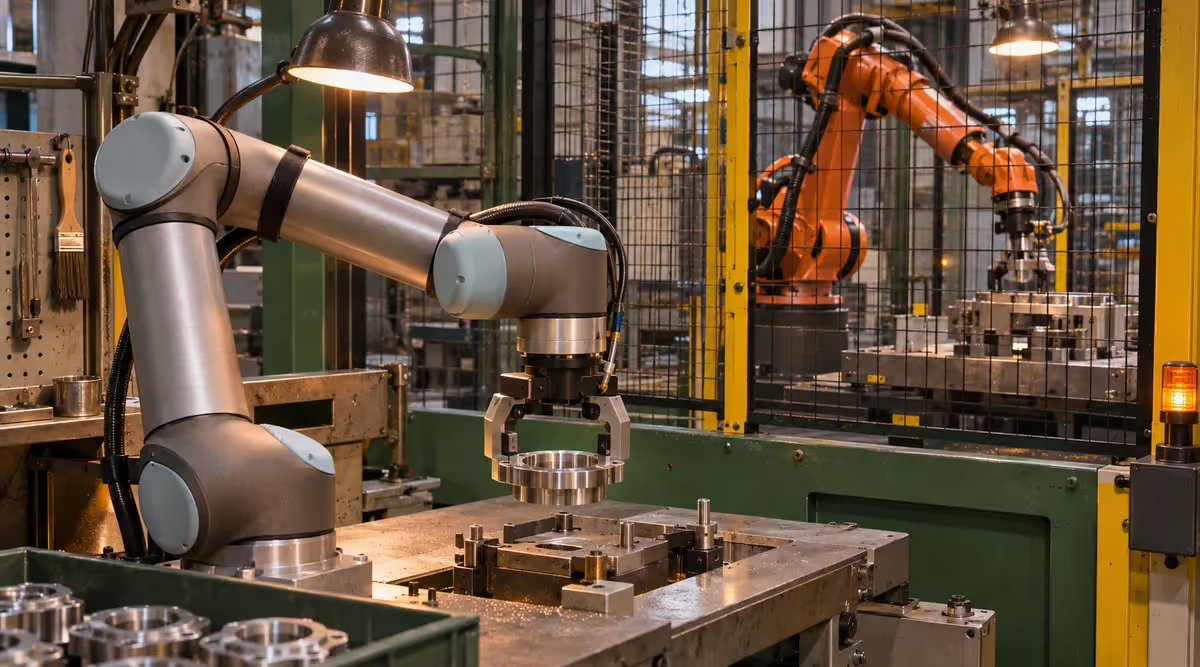
Machine loading and unloading, light assembly, vision inspection, light palletizing and stations shared with operators.
What data is needed for an assessment?
Part and variants, payload with tooling, required cycle, precision, space, safety, integration and total cell cost.
In this article
Industrial robotics in 2027 is not defined by the number of arms installed, but by the quality of the applications. The cases that grow share one trait: the task is well defined, the part can be fixed and the result can be measured.
Where cobots are growing
- Loading and unloading CNC, injection molding or press machines.
- Light assembly and screwing.
- Inspection with machine vision.
- Light palletizing and end-of-line tasks.
- Stations that share space with operators.
The cobot’s advantage is not only the arm: it is the ability to integrate a station without redesigning the whole line.
Where industrial robots still win
- Arc welding and high-repeatability applications.
- Heavy-part handling.
- Demanding cycles and sustained production.
- Tasks where safety requires a fenced cell.
The industrial robot does not compete with the cobot on flexibility; it competes on cost per cycle, payload and repeatability.
What does not change
Safety assessment, total cell cost, tooling, programming and maintenance still define the result. A poorly integrated cobot can be more expensive and slower than a well-designed special-purpose machine.
How to assess a complete cell
The decision is not in the arm, but in the cell. To compare alternatives, build a matrix with:
- real payload with tooling and inertia;
- reach and access to the part;
- required cycle and peak cycle;
- precision and repeatability;
- safety and shared space;
- tooling and reference change;
- integration with PLC, vision and systems;
- maintenance and spare parts.
A cobot with a heavy tool or a difficult part may need more safety than an industrial robot in a closed cell. The comparison must include those peripherals, not just the equipment.
The cost you do not see
The arm price is usually the most visible and least decisive part. Total cost includes integration, programming, safety, training, maintenance and the cost of changing the cell when the product changes.
There is also an opportunity cost: if the cycle is not enough, the investment does not recover the capacity it promised. Before buying, test the cycle with real parts and measure human intervention.
What to assess before investing
- Part, variants and change frequency.
- Real payload with tooling.
- Required cycle and peak cycle.
- Safety and shared space.
- Integration with systems and maintenance.
- Total cost and payback with real data.
Technology changes. The criteria for choosing do not.
Safety and risk assessment
Robotic cell safety is assessed on the complete application. ISO/TS 15066 complements ISO 10218 requirements for collaborative systems; OSHA notes that many accidents occur during non-routine operations such as programming, maintenance or adjustment, when a person enters the workspace.
Before installing, review:
- which tool and part can make contact;
- which force and pressure the application allows;
- which operating modes exist;
- which guards or sensors are required;
- how the emergency stop is tested;
- how programmers and maintainers are trained.
A cobot may reduce the need for fencing in some cases, but it does not eliminate the assessment. Safety is an engineering decision, not a catalog feature.
How to prepare the part and tooling
Robot repeatability depends on part repeatability. If the part arrives with variation, the robot repeats the motion but does not fix the problem. That is why the project includes fixturing, tooling and incoming part control.
Useful questions:
- Can the part always be fixed in the same position?
- Which tolerances must the robot absorb?
- Is vision or a search mechanism required?
- How long does a reference change take?
- Who validates the first part of each lot?
The cell does not end at the robot. It ends at the part that comes out right, consistently.
How to build a business case
The business case is not built on the robot price. It is built on the current cost of the operation: hours, rework, stops, quality and safety. Then the cell is compared against that baseline.
A reasonable case includes:
- total cell investment;
- operating and maintenance cost;
- savings from cycle, quality or safety;
- volume and useful-life assumptions;
- risks and sensitivity.
If volume drops or the product changes, the payback changes. Documenting those assumptions allows the decision to be reviewed instead of defended.
Next 90 days
Choose one task, measure the current cycle and collect real parts. Then compare industrial robot, cobot and special-purpose machine on the same criteria. Include safety, tooling, integration and total cost.
If the comparison is inconclusive, a data point is probably missing. Before buying, run a pilot or proof of concept with the real part.
In summary
Robotics in 2027 is not decided by the equipment label, but by the application. Measure the part, cycle, safety and total cost before choosing. If the case does not hold with data, no trend will hold it.
The best way to evaluate an investment is to compare the complete cell against the current operation. That exercise often shows the problem was not the robot, but the flow, fixturing or reference change.
Continue reading
- Industrial robot vs cobot
- Industrial cobot: what it is and when it fits
- Robotics for businesses The comparison should include integration cost and commissioning time, not only the equipment. The final decision should be explainable with data, not preferences. A clear decision record also helps when the product or volume changes. The same criteria should be revisited when the product mix changes. The business case should be reviewed, not defended. Data beats intuition in every review. The best automation is the one that can be operated, maintained and improved by the team. That is the real test of a robotics investment: the team can sustain it after the project. Document the assumptions so the next review starts from evidence, not memory.