
Industrial process automation: what it is and how to start
Frequently asked questions
What is the difference between industrial automation and process automation?
Industrial automation usually refers to equipment and control on the plant floor. Process automation focuses on the complete flow: inputs, rules, transformation, outputs and owners. One can include the other.
Should every process be automated?
No. If the process is not stable, volume does not support the investment or the product will change, it is better to fix or wait. Automation does not correct a poorly defined process.
Where should I start?
With the problem that hurts most and can be measured. Then compare alternatives and choose a pilot with clear acceptance criteria.
How long does a project take?
It depends on scope. A control or monitoring pilot can take weeks; a robotic cell or a complex integration can take months. The roadmap should separate stages and decisions.
In this article
Industrial process automation does not start with a robot or a software platform: it starts with a process that repeats, has an input, a transformation and an output that can be measured. When that sequence is stable, part of it can be automated; when it is not, the first step is to stabilize it.
This guide explains what process automation means, the main process types and how to move from an operational problem to a roadmap with priorities.
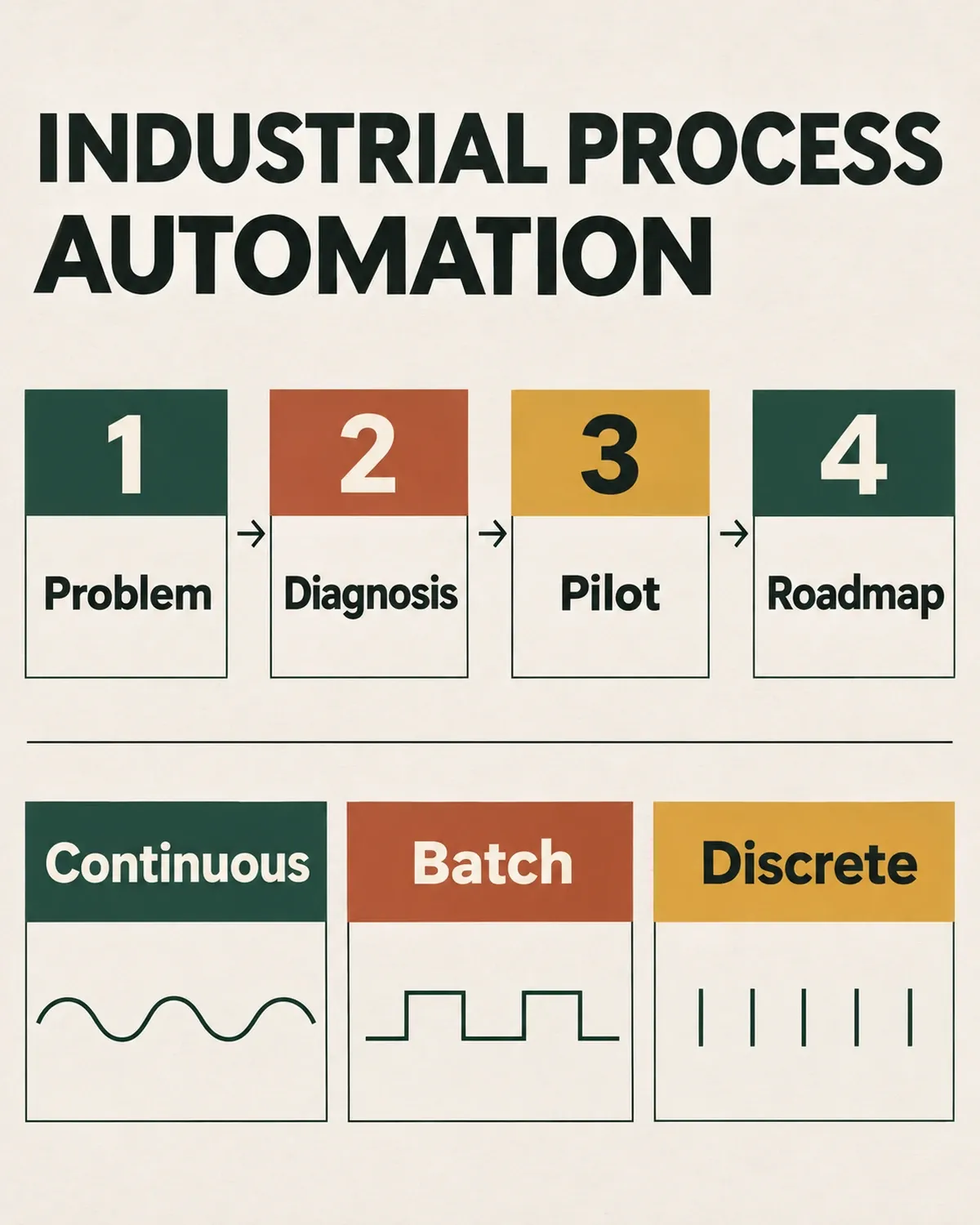
From operational friction to a staged roadmap, depending on the process type.
What industrial process automation means
It is the use of controls, sensors, equipment, software or a combination of them to execute part or all of an industrial process with less manual intervention, more repeatability or better visibility. It can automate a unit operation (welding, dosing, packaging), a sequence (load, process, unload) or an information flow (order, production, quality, maintenance).
It is not the same as digitizing. Digitizing replaces a paper record with a digital one; automating changes who or what performs the action. Many companies need to digitize first to measure, and then automate what is already stable.
Three process types, three approaches
| Process type | Characteristic | What is usually automated first |
|---|---|---|
| Continuous | Uninterrupted flow, stable variables | Variable control, alarms, dosing, in-line quality |
| Batch | Lots with recipes and product changes | Sequences, dosing, traceability, recipe changes |
| Discrete | Units or parts with repeatable operations | Handling, assembly, welding, inspection, palletizing |
The process type defines risk and architecture. In continuous processes, a stop or deviation can be costly; in discrete processes, part variability is usually the main challenge. In batch processes, recipes and cleaning between lots often explain most of the lost time.
Where the opportunity usually is
- Repetitive tasks that depend on a person for the whole shift.
- Operations with variability that create rework or complaints.
- Bottlenecks that limit line capacity.
- Stops that are detected late or not recorded.
- Data copied by hand between systems or spreadsheets.
- Roles with ergonomic or safety risk.
The opportunity is not always new equipment. Sometimes it is a rule, an integration, a sensor or a sequence change. The cheapest automation is often the one that removes a wait or an unnecessary decision before moving a machine.
How to prioritize without overbuying
- Define the operational problem. Not “we need automation”, but “this line loses X hours per week for this reason”.
- Measure the baseline. Volume, cycle, stops, rework, cost per unit and manual intervention hours.
- Separate cause from symptom. A jam may be a flow problem, not a robotics problem.
- Compare alternatives. Process improvement, controls, sensor, software, robot or special-purpose machine, with total cost and risk.
- Start with a scoped pilot. An scope that can be tested and measured before scaling.
What data you need
- description of the current process, even if undocumented;
- volume, cycle, shifts and variability;
- products, variants and change frequency;
- quality, tolerances and acceptance criteria;
- space, safety, utilities and regulatory constraints;
- existing systems and available data;
- business objective and budget.
With that data, you can decide what to automate first and what to leave for a second stage. Without it, any proposal is a bet.
Common mistakes
- Automating a process that is not stable yet.
- Buying equipment before defining the flow.
- Measuring only purchase cost and not total operating cost.
- Ignoring maintenance, training and spare parts.
- Automating a task that will disappear with the next product.
How to run a diagnosis that is actually useful
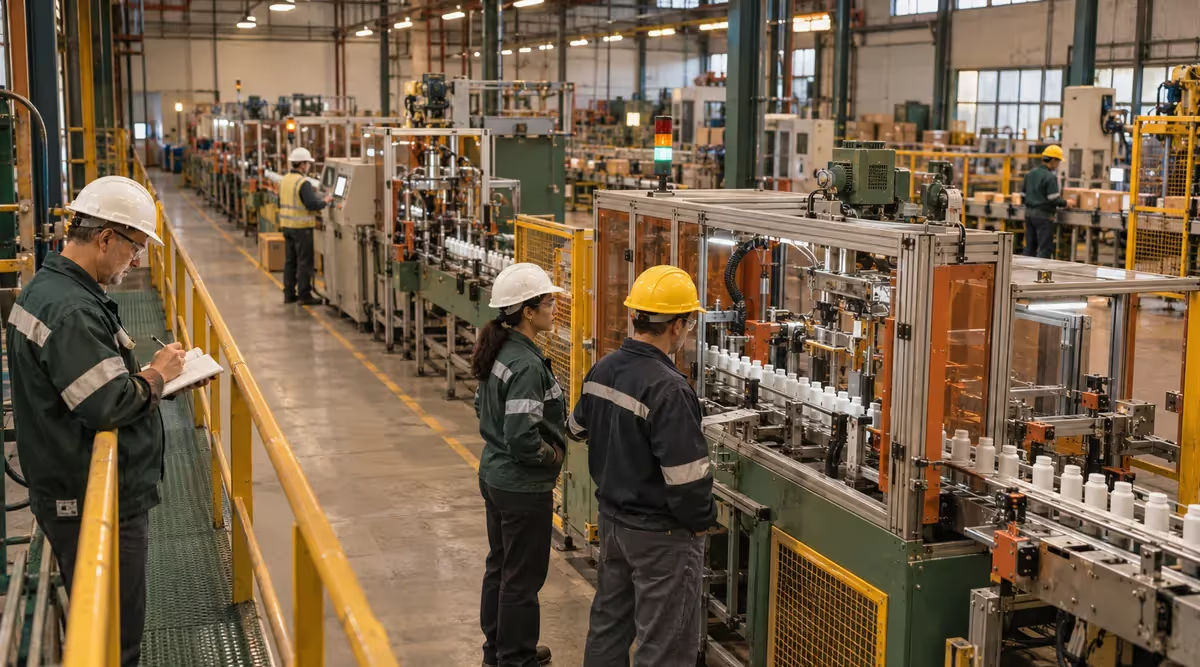
A useful diagnosis is not a technology list. It is a reconstruction of the real process, with its exceptions, owners and data. On the plant floor, observe the work during a shift, talk to the people who operate it and compare the documented procedure with what happens when something goes wrong.
The assessment should answer:
- where the process starts and ends;
- what enters, what is transformed and what leaves;
- who decides at each step and with what information;
- which exceptions occur and how they are resolved today;
- what is measured and what is not;
- where work accumulates and why.
Then separate process improvement from technology. Sometimes the bottleneck is fixed by changing a rule, a sequence or a dashboard; other times control, sensors or a cell are required. The diagnosis must distinguish both cases before quoting.
The pilot: scope, metrics and acceptance criteria
A well-designed pilot tests a bounded hypothesis: “if we automate this part, cycle time drops from X to Y” or “if we measure this variable, stops are detected earlier”. It does not test the whole plant or promise a payback that cannot be calculated yet.
Before starting, define:
- the exact scope and what is out of scope;
- the baseline for volume, cycle, quality and cost;
- the metric that will decide whether the pilot worked;
- the test period and the cases included;
- what happens if the result is not enough.
A pilot without a baseline cannot prove anything. A pilot that promises too much usually ends up justifying the purchase instead of evaluating it.
Governance: who decides and how it is documented
Automation changes responsibilities. Someone must approve scope, validate the process, accept delivery and sustain operation after go-live. If those responsibilities are unclear, the project moves on momentum and stops at the first exception.
Document the important decisions: why that process was chosen, which alternatives were discarded, which assumptions support the payback and what remains open. That record serves the next stage, prevents repeated debates and lets another person —or another vendor— continue without starting over.