
How to choose an industrial automation consultant
Frequently asked questions
How much does automation consulting cost?
It depends on scope. A focused diagnosis can have a fixed price; a full plant assessment takes more time. Compare scope and deliverables, not just price.
How long does a diagnosis take?
A focused diagnosis can take two weeks; a multi-process assessment takes longer. The proposal should separate stages and decisions.
Can the consultant also implement?
They can, but decision and execution should be separated at least during evaluation. If the same vendor recommends and sells the equipment, ask for criteria and alternatives in writing.
What deliverables should I ask for?
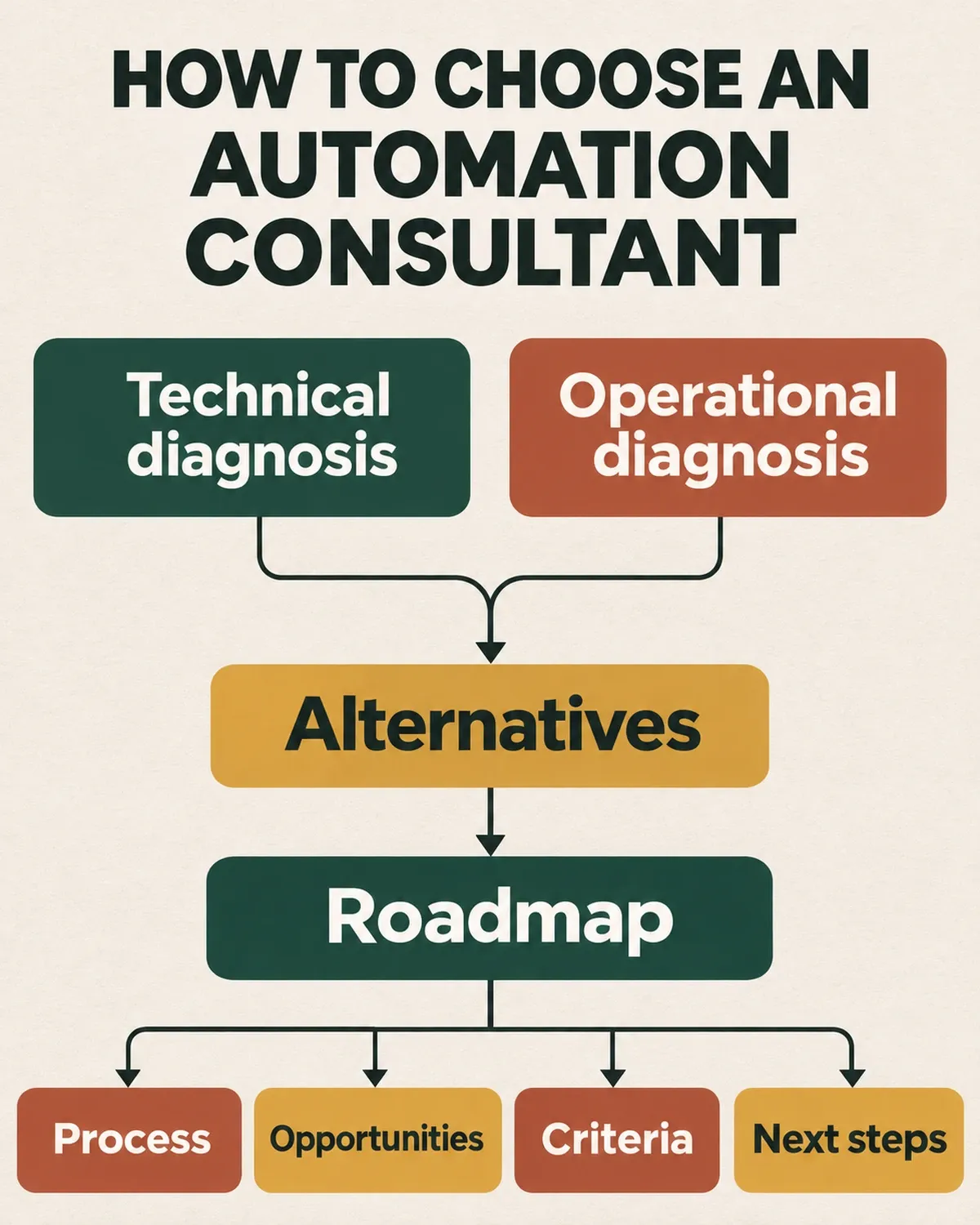
Process map, opportunity matrix, alternatives with total cost, decision criteria, risks, assumptions and a roadmap. If the main deliverable is a catalog, it is not consulting.
In this article
Hiring an automation consultant should not start with price or robot brand. It should start with a question: can this person or team help me decide what to automate, in what order and with what evidence?
Good consulting reduces the risk of buying technology that does not solve the problem. Bad consulting adds a long report and a list of equipment disconnected from the operation.
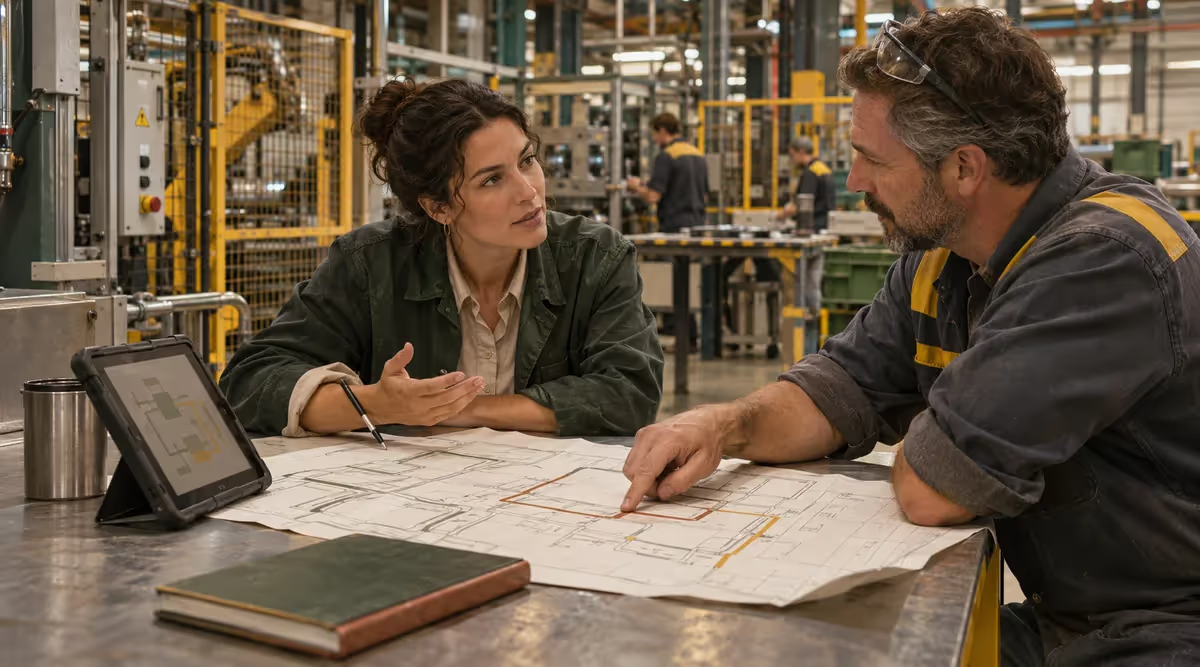
A good diagnosis covers technical feasibility and operational sense before recommending technology.
What an industrial automation consultant does
- Assess the current process and its constraints.
- Identify opportunities and bottlenecks.
- Compare technical and economic alternatives.
- Estimate impact, effort and dependencies.
- Propose a roadmap with stages and decision criteria.
- Support specification and vendor evaluation.
It is not the same as an integrator. The integrator executes a solution; the consultant helps decide which solution makes sense. In small projects both roles can coexist, but it should be clear who is making each decision.
What a proposal should include
- Scope and questions. Which process, which decisions and which limits.
- Method. How the consultant will assess, measure and compare.
- Deliverables. Process map, opportunity matrix, alternatives, criteria and next steps.
- Effort. Hours, meetings, visits and client responsibilities.
- Timeline. Stages and delivery dates.
- Assumptions. What data is needed and what happens if it is missing.
- Independence. Whether the consultant earns commissions from equipment or vendors.
How to evaluate the consultant
- Do they ask about the process before talking about technology?
- Do they separate symptom from cause?
- Can they explain similar cases with data, not just anecdotes?
- Do they include alternatives or only one solution?
- Do they define what should not be done?
- Do they leave documentation another team can use?
- Is their value proposition a report or a decision?
Warning signs
- Promising an exact payback without production data.
- Recommending a brand before understanding the part.
- Not distinguishing technical diagnosis from operational diagnosis.
- Delivering a report without prioritization criteria.
- Omitting maintenance, training or total cost.
- Changing scope without changing the price.
Technical vs operational diagnosis
A technical diagnosis answers whether a solution is feasible: access, power, safety, integration, precision, cycle. An operational diagnosis answers whether it makes business sense: volume, cost, quality, people, maintenance and payback.
A project needs both. A technically feasible solution can be operationally unviable, and an operational opportunity may have no reasonable technical solution.
Questions for the first conversation
- What problem are you trying to solve and how do you measure it today?
- What have you tried and what result did you get?
- What budget, timeline and operating constraints exist?
- Who will operate and maintain the solution?
- What happens if you do nothing?
The answers usually say more than any corporate presentation.
How to read a diagnosis
A serious diagnosis shows the reasoning, not just the conclusion. It should reveal what was assessed, which assumptions were used, which alternatives were compared and why they were discarded. If the document only says “X is recommended”, it is not enough to decide.
Look for these signals:
- Evidence: process data, volumes, cycles, stops, quality.
- Assumptions: what was assumed and what happens if it does not hold.
- Alternatives: at least two comparable paths.
- Risks: technical, operational, safety and adoption.
- Criteria: why one option wins and what would change the answer.
- Next steps: which decision follows and who owns it.
A good diagnosis also says what not to do. That part often saves more money than the main recommendation.
What happens after the roadmap
The roadmap does not finish the project: it organizes decisions. Specification, vendor comparison, implementation and commissioning follow. If the consultant supports that stage, separate roles: recommending is one thing; selling the equipment is another.
During implementation, hold on to what the diagnosis defined: scope, acceptance criteria, safety, training and documentation. If the vendor changes scope without changing price, or cannot explain how delivery is tested, the roadmap dilutes.
Checklist to evaluate a proposal
- Is the scope written with clear boundaries?
- Does it include method, effort and timeline?
- Does it distinguish technical from operational diagnosis?
- Does it present alternatives and decision criteria?
- Does it include risks, assumptions and dependencies?
- Does it define deliverables another team can use?
- Does it disclose whether the consultant earns vendor commissions?
- Does it propose how the result will be measured?
If the proposal does not answer these questions, price should not be the first criterion.
How consulting success is measured
Consulting is not measured by report length. It is measured by the quality of the decision it enables: does the team understand what to do first? Are the alternatives comparable? Are risks visible? Does the next step have an owner and a budget?
Reasonable indicators:
- a decision made with explicit criteria;
- a scope that can be quoted;
- fewer open questions than at the start;
- a plan the team can execute or tender;
- documented assumptions and risks.
If at the end the conversation is still “we need to automate”, the work is not done.
In summary
Choosing a consultant means choosing a decision framework. Look for evidence, alternatives, assumptions and deliverables you can use. If the proposal does not help you decide, it is not consulting: it is a presentation.
In summary
A good consultant leaves you with a better decision, not a longer report. Ask for evidence, alternatives, assumptions and next steps.