
ERP vs custom software: how to decide
In this article
The short answer is this: an ERP often makes sense when most of the operation is standard and you need speed, modules, and a known ecosystem. Custom software is more appropriate when your own logic differentiates the business and does not fit an existing tool well. For many companies, the best answer is a standard system combined with integrations and specific development.
The question behind “ERP or custom?”
This is not about choosing the most complete technology. It is about deciding which parts of the operation are common capabilities and which contain rules, costs, approvals, or experiences the company needs to control differently.
An ERP can organize accounting, purchasing, inventory, sales, or invoicing through known processes. That does not mean it should absorb every business workflow. A forced module can lead to parallel spreadsheets, hard-to-maintain customizations, or manual work outside the system.
Decision matrix
| Criterion | ERP or standard product | Custom software |
|---|---|---|
| Process | Resembles a common practice | Has specific rules and exceptions |
| Initial time | Faster when scope is defined | Requires discovery, design, and validation |
| Differentiation | Follows product conventions | Can represent differentiating logic |
| Integration | Depends on modules, APIs, and real limits | Designed around existing systems |
| Evolution | Follows the vendor roadmap | Depends on architecture and maintenance agreement |
| Risk | Adoption, configuration, and dependency | Scope, quality, support, and continuity |
| Total cost | Licenses, implementation, users, and changes | Design, development, infrastructure, and evolution |
The matrix does not replace a diagnosis. It makes visible the variables that the initial price often hides.
When an ERP wins
An ERP is usually a strong base when the process is stable, a mature solution exists, the team can adopt its conventions, and the main value is centralizing known modules and controls. It may also be preferable when you need implementation speed, ecosystem support, and a roadmap you do not want to maintain internally.
That still requires reviewing migration, permissions, reports, integrations, training, and operating cost. Buying a license is not the same as having the process working.
When custom software wins
Purpose-built development may be justified when a calculation rule, approval sequence, user experience, or integration is central to the business. It can also make sense when a standard product forces people to copy data, maintain workarounds, or explain the process around the tool.
The decision should include who maintains the code, where it is hosted, what documentation is delivered, how errors are corrected, and how new versions are prioritized. Without that conversation, “custom” can become a different kind of dependency.
The third path: standard plus a specific layer
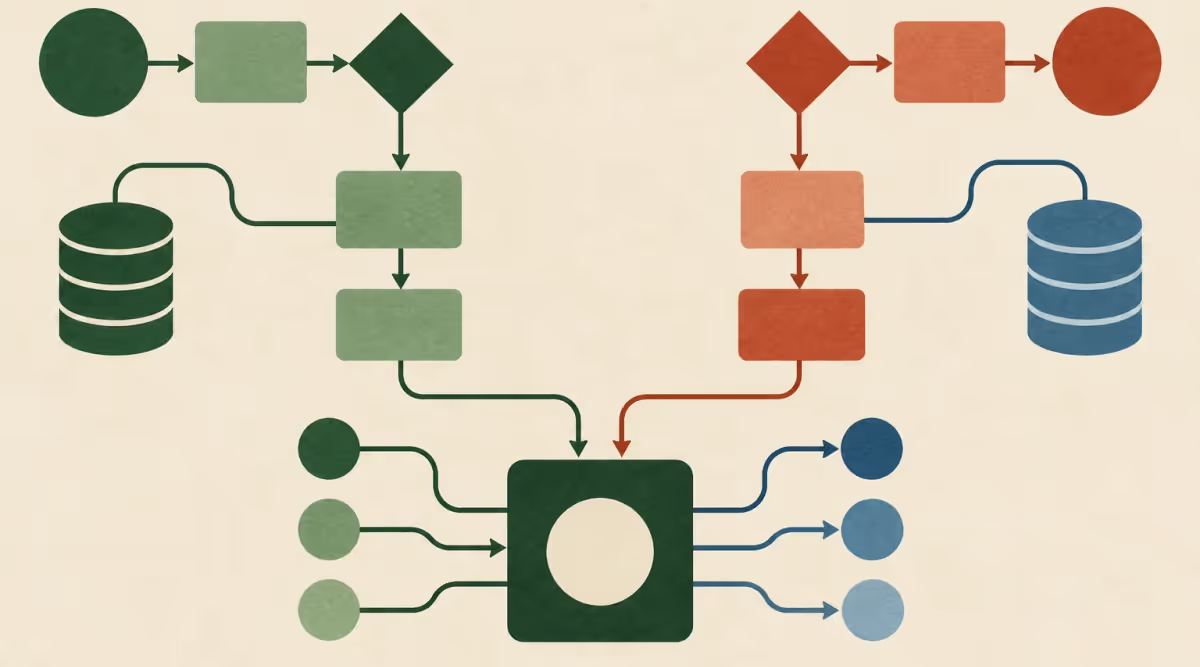
A combined architecture can leave the ERP responsible for common capabilities and reserve a specific platform or application for the differentiating workflow. Integrations move the necessary information between both worlds, with a clear source for each data point.
This is useful when a company already invested in systems that work but needs to improve one part of the operation. Before replacing anything, review how to integrate disconnected systems and separate integration from new development.
Analyzed scenario: a distributor with its own cost rules
This is a composed scenario to explain the reasoning, not a client testimonial. The distributor uses an ERP for inventory, invoicing, and purchasing. Its difficulty is quoting orders with margin, logistics, and availability rules that change by customer and region.
In that case, discarding the ERP because the quoting flow does not fit would not be reasonable. One option is to keep it as the system of record, build a specific quoting interface, and integrate both workflows. If the rules are simple and the standard module is enough, custom development may not be justified.
You can review the business platform, custom software development, and technology integration pages for each path.
What could change the decision?
The recommendation changes if the process stops being differentiating, the ERP offers a stable integration, the volume does not justify maintaining a custom layer, or regulation requires controls the standard product already provides. It also changes if the team cannot participate in validation and evolution.
Total cost and risk
Compare licenses, implementation, migration, customizations, integrations, infrastructure, training, updates, support, and the cost of making the wrong decision. For custom development, add scope, testing, security, documentation, team continuity, and maintenance. In both cases, measure adoption: a system nobody uses is not cheaper because it is standard.
If you do not yet know which path fits, a technology assessment can structure the decision before committing to a purchase or build.