
AI vs automation (and AI automation): when to use each
Frequently asked questions
Is AI a form of automation?
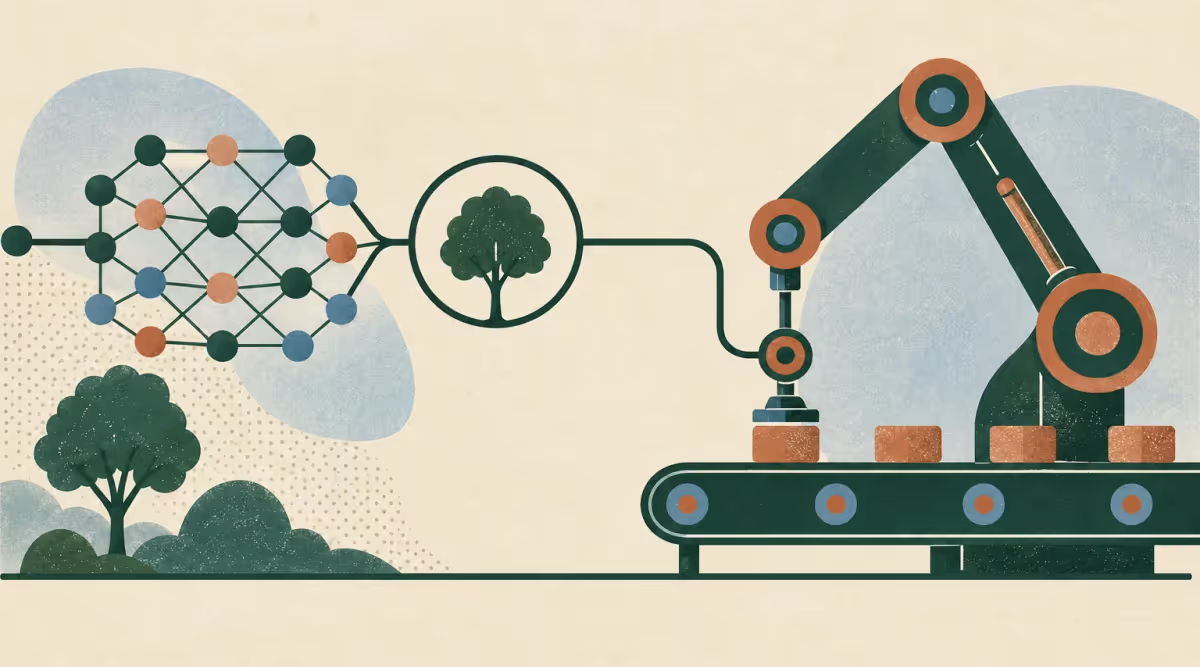
AI can be part of an automation, but it is not a synonym. Automation executes a defined workflow; AI provides interpretation of ambiguous inputs. In practice, the most robust combination is usually AI to interpret and rules to validate and execute.
Does AI automation replace rules?
No. Rules are still needed to validate fields, enforce permissions, calculate status, and define what happens when interpretation fails. AI expands the input the workflow can accept; it does not remove controls.
What is the difference between AI and automation?
Automation executes defined rules: if A happens, do B. AI interprets ambiguous information, such as text, documents, or images, and proposes a classification or response. In a real process, the strongest option is usually a combination: AI interprets, while automation validates, executes, and escalates.
Is AI always better than a rule?
No. If the input is structured, a rule is easier to test, audit, and maintain. AI adds value when there is language, documents, images, or exceptions that cannot be described with a simple rule.
When should I not use AI?
When volume is very low, the cost of error is high and there is no human review, sources are not up to date, or the process is not yet defined. In those cases, organize the process first and measure where time is lost.
How is an AI pilot evaluated?
With a test set, real cases, escalation thresholds, and agreed metrics: accuracy, escalation rate, corrections, time saved, and cost per interaction. Without a baseline, you cannot claim AI adds value.
In this article
Use traditional automation when inputs, rules, and outputs can be described clearly. Consider AI when the task receives language, documents, images, or ambiguous situations that require context to be interpreted. In real processes, the strongest option is often hybrid: AI interprets or proposes while rules validate, execute, or escalate.
The question behind “do I need AI?”
The decision does not start with the model. It starts with input variability and the cost of being wrong. If every case has the same structure, a deterministic rule is easier to test, audit, and maintain. If information arrives in different formats or requires understanding, AI may provide a first interpretation, with appropriate limits and review.
Decision matrix
| Criterion | Traditional automation | Applied AI |
|---|---|---|
| Input | Structured and predictable | Text, documents, images, or ambiguous signals |
| Rule | Can be written explicitly | Requires inferring intent, class, or context |
| Auditability | Reproducible and easy to explain | Needs sources, evaluation, and logging |
| Exceptions | Modeled as conditions | Can detect patterns but needs fallback |
| Cost | Usually more stable per execution | Depends on model, volume, context, and latency |
| Control | Workflow, permissions, and validations | Supervision, boundaries, permissions, and review |
The table does not say one technology is generally better. It helps identify which part needs interpretation and which part needs operational discipline.
When a rule is enough
A rule is often enough to validate fields, calculate states, send due-date alerts, assign a task by condition, or stop a flow without a required value. It is also preferable when predictability is critical and exceptions are limited.
Adding AI to that section may introduce cost, latency, and an error surface without improving the decision. First organize the process and measure where time is lost.
When AI can help
AI can help interpret an email, summarize documentation, classify a question, search internal sources, or suggest a next action. The value appears when it reduces reading and preparation work, not when it replaces a decision the team has not yet defined.
Reliable answers need context and trustworthy sources. In a document-heavy case, the knowledge core may matter more than changing models. In an assistant, define when it answers, when it shows a source, and when it escalates to a person.
The third path: AI interprets and automation executes
Imagine customer orders arriving by email in different formats. An AI layer can extract customer, products, and tentative date. Rules then verify required fields, check availability, identify exceptions, and leave approval with a person when risk requires it.
This division lets you test interpretation value without giving a model full process control. Process automation develops this boundary, while technology integration covers exchange with existing systems.
Analyzed scenario: receiving orders
This is a composed scenario, not a real case. A company receives orders by email, PDF, and messages. The team copies data into a system, checks prices, and verifies availability.
Traditional automation can control registration, fields, states, and notifications. AI can help read variable formats and flag uncertain information. Approval of out-of-policy prices and resolution of shortages remain human decisions.
An initial metric could be preparation time per order, the share of orders needing correction, and the percentage the system can leave ready for review. Without a baseline, there is no serious way to know whether AI adds value.
What could change the recommendation?
The recommendation changes if emails become standardized, volume is very low, error cost is high, sources are not current, or no person can review exceptions. It also changes if the task needs vision, prediction, or an integration with action permissions.
Cost, quality, and control
Beyond development, consider cost per query, context storage, latency, monitoring, evaluation, source updates, and human review. Do not promise absolute accuracy: define a test set, escalation thresholds, and what happens when the answer lacks support.
To understand which technology fits before choosing, review the Applied artificial intelligence page and request a technology diagnosis.
AI automation: what it is and how it differs
AI automation describes a process where a model interprets ambiguous information and the automated workflow executes the action. It is not the same as “AI vs automation”: here they do not compete, they combine.
An example: a purchase order arrives as a free-form email. AI extracts customer, products, and requested date; a rule validates that the customer exists, checks stock, and routes the order for review if a field is missing. AI does not replace the workflow: it reduces reading and preparation work.
AI automation makes sense when the input is variable and the cost of error is controlled with validation, permissions, and human review. If the input is already structured, a rule remains simpler, cheaper, and easier to audit.
Intelligent automation vs traditional automation
Traditional automation executes explicit rules: if A happens, do B. Intelligent automation adds interpretation, classification, or prediction to handle cases that cannot be described with a simple rule. The difference is not “better or worse”, but which part of the process needs understanding and which part needs operational discipline.
| Situation | Reasonable approach |
|---|---|
| Form with fixed fields | Traditional automation |
| Email or document with variable format | AI automation + validation |
| Case classification with exceptions | AI with an escalation threshold |
| Deterministic calculation, status, or notification | Rule or workflow |
Governance: what makes AI sustainable
An AI solution does not end when the demo works. It needs an owner, documentation, metrics and a process to review responses. Management frameworks such as ISO/IEC 42001 and the NIST AI Risk Management Framework agree on the same points: define roles, document decisions, assess risks and keep evidence that the system behaves as expected.
In practice, that means:
- recording which model version and sources were used;
- defining who reviews responses and with what criteria;
- measuring accuracy, escalation and corrections;
- documenting what happens when the model does not know;
- reviewing the system when data or the process changes.
Without governance, AI becomes a black box nobody dares to touch. With governance, it can improve without breaking what already works.